
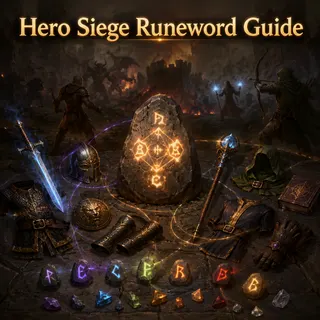
Getting the right equipment in Hero Siege does not mean replacing every item as soon as something with slightly higher stats drops. During the early and mid game, the better strategy is to build around a few reliable upgrades and replace gear only when it provides a meaningful improvement.
Runewords are especially useful during this stage because they can turn relatively basic equipment into powerful temporary upgrades. Knowing which Runewords are worth making, where to find the required Runes, and when to replace them can make the journey from Normal to Hell much smoother.
Why Runewords Matter Early
Runewords are valuable because they provide predictable bonuses instead of relying entirely on random loot. This is particularly useful when your character has reached a point where ordinary drops are no longer keeping up with enemy damage or health.
The key is not to waste rare Runes on equipment that you will replace after a few zones. Early Runewords should be treated as efficient stepping stones toward stronger endgame equipment.
Before creating one, check the base item carefully. A good Runeword in a poor base can still be a bad investment.
Best Early Runeword Options
For early progression, defensive and utility-focused Runewords are generally safer investments than extremely specialized damage setups.
A weapon Runeword is usually the most noticeable upgrade for characters struggling to kill enemies. Faster attacks, additional damage, or useful elemental effects can dramatically improve clear speed.
For fragile characters, armor-based Runewords can be more valuable. Extra survivability allows you to survive difficult encounters without constantly stopping to recover.
Players should prioritize Runewords that directly support their build rather than choosing one simply because its stats look impressive. A caster, melee character, and ranged attacker can have completely different priorities.
Finding and Upgrading Runes
Runes naturally become more important as you progress through higher difficulties. Early Runes are relatively easy to replace, while higher-quality Runes should be saved for upgrades that can remain useful for a significant portion of the campaign.
Do not automatically combine every Rune you find. Keep track of what your next upgrade requires before spending materials.
A simple rule works well:
- Common Runes can be used for early progression.
- Better Runes should be saved for meaningful weapon or armor upgrades.
- Rare Runes should generally be reserved for strong bases.
- Avoid crafting expensive Runewords immediately before entering a new difficulty unless the upgrade will remain useful.
This approach also helps control your overall spending. If you are considering whether to buy Hero Siege Items for an early character, remember that campaign gear is temporary. Farming and crafting a practical Runeword is often enough to carry a character through several stages of progression.
Normal: Focus on Functional Gear
Normal difficulty is primarily about establishing your build. You do not need perfect equipment.
Look for weapons with reliable damage, armor with useful defensive stats, and accessories that support your main abilities. If you find the correct base for an inexpensive Runeword, it can be worth using.
However, do not spend valuable resources trying to create a perfect Normal setup. You will replace most of these items relatively quickly.
Nightmare: Start Replacing Temporary Gear
Nightmare is where equipment choices become more important. Enemy damage increases, and weak defensive stats become much easier to notice.
This is the ideal point to replace outdated Normal gear rather than trying to keep everything indefinitely. A strong early Runeword can remain useful here, but once a rare or better-quality item offers a major improvement, there is little reason to stay attached to the old setup.
Nightmare is also a good farming stage for preparing your character for Hell.
Hell: Stop Treating Gear as Permanent
Hell is where temporary equipment begins to separate from true endgame gear. You should now be looking for stronger bases, better combinations of stats, and equipment that complements your final build.
A Runeword that carried you through Normal and Nightmare may still work, but do not assume it must remain equipped forever.
The most efficient progression usually looks like this:
Normal → Basic gear and cheap Runewords → Nightmare → Upgrade weak slots → Hell → Replace temporary gear with endgame pieces
The biggest mistake is spending too many resources too early. Even if you decide to buy Hero Siege Items, prioritize upgrades that solve an immediate problem rather than collecting expensive equipment before your build is ready for it.
Build for the Next Stage
The best early-game gear strategy in Hero Siege is about timing. Use inexpensive Runewords to solve immediate problems, save valuable Runes for worthwhile bases, and replace equipment when you reach a difficulty where its weaknesses become obvious.
Normal should be about getting your build running. Nightmare should be about strengthening weak equipment and preparing for harder content. Hell is where you begin turning that temporary setup into a proper endgame character.
Runewords are not the destination. They are one of the most effective tools for getting your character there.
